Crescent City-State of Mirazh
The sky looks fake above Mirazh. Too perfect, too eager; As though painted for an audience. But the water beneath is honest. It reflects not the heavens, but the wound that made the island. As I gazed downward into the sea, I wondered whether the city was built to celebrate survival... or to distract itself from remembering the fall.
— Historian Marev Ilyasin, Along the Coast of Wonderland
Crescent City-State of Mirazh
Official Name: Mirazh, City of Reflections
Demonym: Mirazhi
Government: Ceremonial spectacle state with oligarchic patron council
Capital: Mirazh (city-state)
Motto Themes: Illusion • Desire • Reinvention
National Color: Iridescent Silver-Purple
Symbolic Animal: Glass Serpent
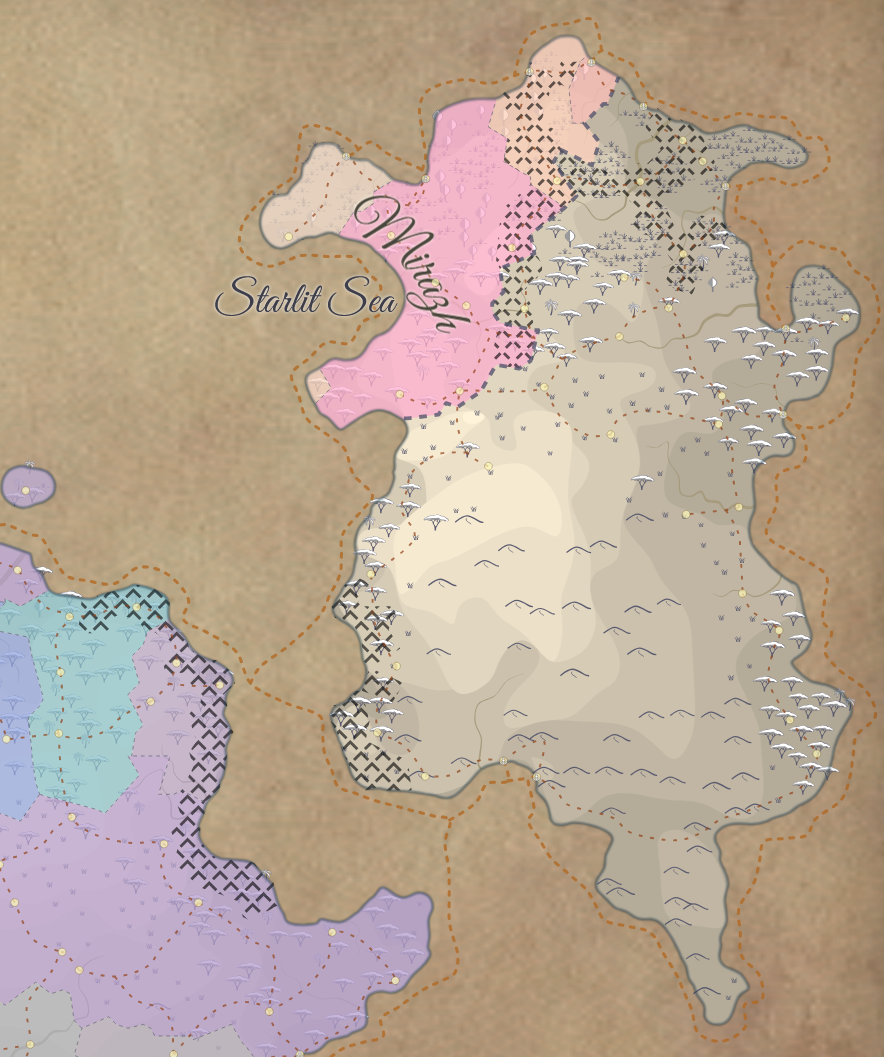
Overview
The island on which Mirazh stands is widely believed by most historians and researchers to have been formed by a celestial impact in times that precede even written history. The discovery of the massive crater basin now filled by the tranquil inland sea is most often agreed to be attributed to the explorer Khaled Marezin, a figure whose existence sits uneasily between documentation and legend. Merchant ledgers from early coastal trade routes mention a "Marezin Expedition" that vanished for several months before returning with fragments of glowing stone and a description of a crescent-shaped island whose waters "shone like fallen stars." These accounts are widely accepted as the earliest written reference to Mirazh.
The reliability of this account is questionable, though the author's description of the Starlit Sea is accurate.
— Compiler's Note
Researchers have long discussed the contradiction between the violent origin of the formation and the unnaturally calm waters of the Starlit Sea. Storms batter the outer coast relentlessly, yet the inner lagoon remains placid even during tempest that should logically disturb it.
It is often matter of debate whether early settlers interpreted this calm as divine protection or as an invitation. The dominant founding myth claims that Mirazh was not established by conquest or design, rather by convergence. Survivors from distant lands allegedly arrived here independently, drawn by reports of glowing waters and stones that shone beneath the surface. No single founder is recorded in any early account. Instead, oral traditions speak of a spontaneous assembly of strangers who chose not to leave.
Some scholars argue this myth is a deliberate political invention, meant to justify the city's modern ideology of openness and reinvention. Others believe the absence of a founding myth to be too consistent across competing traditions to be fabricated. To the dismay of many historians, the truth remains contested.
The Zarakh or Mirazite
Fragments recovered from the lagoon's floor, popularly called Zarakh, remain one of Mirazh's enduring mysteries. These minerals emit faint light and carry minor but consistent magical properties. While their effects are generally trivial from a practical standpoint, their cultural impact has been immense.
Researchers have attempted to categorize the stones as remnants of the original celestial body, but the efforts have proven futile so far. Expeditions seeking a central mass beneath the lagoon have repeatedly failed, with divers reporting disorientation and equipment malfunction that forced them away from the basin's deepest point.
What is often a theme of contention is whether the stones' values lies in their properties or their symbolism. They are proof, however small it may be, that the catastrophe that hit the island left behind something that it did not destroy. Mirazh built an entire economy around this paradox: beauty extracted from ruin.
The jungle tribes surrounding the crater consider large-scale removal of the stones to be taboo. Many of them possess oral histories that describe the impact as a wound that must not be reopened. Attempts to negotiate mining rights have historically ended in quiet abandonment rather than conflict, suggesting that even Mirazhi are reluctant to take the extraction of these stones too far.
Modern mineralogists classify the glowing lagoon stones under the technical label of Mirazite, a term popularized by foreign academies attempting to standardize trade catalogues. Regardless, the people of Mirazh reject the word almost unanimously: to them the stones are Zarakh, a name rooted in oral tradition and inseparable from the island's founding myth. Word is that calling a Zarakh by its foreign name is often interpreted as a subtle declaration that the island's cultural ownership is secondary to outside interest. As such, most Mirazhi will usually correct the term once; repeating the mistake is considered discourteous, and in certain districts, outright provocative.
Cultural Identity
Mirazh evolved not as a fortress or trade hub, but as a theater of life.
Early architectural records indicate a pattern of constant demolition and rebuilding. Historians interpret this as a cultural rejection of permanence. Whereas most cities and countries celebrate longevity, Mirazhi celebrate and welcome change. The city's identity is inseparable from spectacle, and spectacle demands novelty.
Travel accounts from foreign merchants often describe the City of Glowing Stars as a place where identity itself is temporary. As one drifts along the river of life, life permanently changes, and one permanently changes as well. Of the visitors of Mirazh, some claim to have completely given up on their previous lives and to have renounced their former names.
Magic in Mirazh occupies a decorative role. Due to the trivial magical properties of Zarakh, most people are in possession of at least one item crafted with it. Some use red Zarakh as a way to heat up the bedding before sleep, others use the slightly more luminous properties of yellow Zarakh to softly light up the pages of a book. Unlike regions that pursue magical dominance or weaponization, the Mirazhi treat magic as a more aesthetic craft.
Governance, and the Illusion of Authority
The political structure of Mirazh is intentionally theatrical. An individual known as the Ringmaster serves as the city's public sovereign, elected through elaborate festivals that turn civic process into performance. Contemporary observers often mistake the position for absolute rulership, yet archival evidence suggests the Ringmaster's authority has always been ceremonial.
According to most outsider merchants, though, true power lies within the House of Masks, an oligarchic council comprised of patrons who control the city's entertainment industries and trade networks. Members conduct official proceedings in anonymity, a practice historians interpret as both symbolic and practical. By erasing their personal identity, the House presents itself as an institution rather than a collection of individuals. Power in Mirazh is meant to feel impersonal, much like the city itself.
A curious opinion of most political historians regarding the City of Glowing Stars is that its stability depends on "managed instability." Periods of cultural and architectural stagnation appear to correlate to financial decline. As such, the House of Masks therefore encourages constant reinvention, ensuring the city never becomes familiar enough to be ignored.
Outside Relations
Relations between the lagoon city and the island's interior tribes can't be examined without also considering the influence of the Tsardom of Sinyara, whose naval superiority effectively determines the island's connection to the outside world. Mirazh is, from all perspectives, a hinge-state: culturally insular, yet economically dependent on the few powers capable of surviving the outer storms. Among these, Sinyara remains the most consistent presence.
The jungle tribes, on the other hand, maintain a cautious distance from both the city and foreign merchants. They trade rare medicinal plants, resins and precious gems in exchange for foreign food or similar resources; yet they refuse to harvest Zarakh themselves, viewing the stones as something that is better left untouched beneath the lagoon. Researchers and adventurers who attempted to document tribal cosmology repeatedly noted a shared belief that excessive removal of Zarakh weakens a boundary that should not be disturbed. The city, by contrast, treats the stones as cultural inheritance and economic foundation, creating an ideological divide that has never escalated into open war, but remains a persistent undercurrent on the island.